Tonight's best places for the northern and southern lights
15 places, ranked by the recipe below. Aurora chance: NOAA OVATION grid observed Nov 04, 07:53 UTC, valid Nov 04, 08:57 UTC. Cloud: MET Norway forecast updated 07:30 UTC.
#1 Fairbanks, United States 11 / 100
26% aurora chance on NOAA's map, 54% average cloud over 12 dark hours, clearest dark hour Wed 00:00 local (8% cloud).
Local time there now: 23:01.
#2 Kangerlussuaq, Greenland 4.2 / 100
11% aurora chance on NOAA's map, 61% average cloud over 13 dark hours, clearest dark hour 20:00 local (9% cloud).
Local time there now: 06:01.
#3 Whitehorse, Canada 4.1 / 100
22% aurora chance on NOAA's map, 81% average cloud over 12 dark hours, clearest dark hour 04:00 local (35% cloud).
Local time there now: 01:01.
| # | Place | NOAA aurora chance | Average cloud, dark hours | Dark hours (local) | Moon | Clearest dark hour | Score |
|---|---|---|---|---|---|---|---|
| 1 | Fairbanks United States, local time now 23:01 | 26% | 54% | 12 h: 23:00 to Wed 07:00 and Wed 19:00 to Wed 23:00 | 23% lit, above the horizon 4 of 12 dark h | Wed 00:00 (8% cloud) | 11 |
| 2 | Kangerlussuaq Greenland, local time now 06:01 | 11% | 61% | 13 h: 06:00 to 08:00 and 19:00 to Thu 06:00 | 14% lit, above the horizon 3 of 13 dark h | 20:00 (9% cloud) | 4.2 |
| 3 | Whitehorse Canada, local time now 01:01 | 22% | 81% | 12 h: 01:00 to 08:00 and 20:00 to Thu 01:00 | 23% lit, above the horizon 4 of 12 dark h | 04:00 (35% cloud) | 4.1 |
| 4 | Churchill Canada, local time now 02:01 | 17% | 96% | 13 h: 02:00 to 07:00 and 18:00 to Thu 02:00 | 14% lit, above the horizon 5 of 13 dark h | 02:00 (49% cloud) | 0.7 |
| 5 | Yellowknife Canada, local time now 01:01 | 21% | 99% | 12 h: 01:00 to 07:00 and 19:00 to Thu 01:00 | 14% lit, above the horizon 4 of 12 dark h | 21:00 (96% cloud) | 0.2 |
| 6 | Reykjavik Iceland, local time now 08:01 | 2% | 92% | 13 h: 19:00 to Thu 08:00 | 14% lit, above the horizon 3 of 13 dark h | 19:00 (29% cloud) | 0.2 |
| 7 | Abisko Sweden, local time now 09:01 | 1% | 86% | 12 h: 18:00 to Thu 06:00 | 23% lit, above the horizon 3 of 12 dark h | Thu 00:00 (77% cloud) | 0.1 |
| 8 | Lofoten (Svolvær) Norway, local time now 09:01 | 1% | 90% | 13 h: 18:00 to Thu 07:00 | 23% lit, above the horizon 4 of 13 dark h | Thu 02:00 (82% cloud) | 0.1 |
| 9 | Tromsø Norway, local time now 09:01 | 1% | 92% | 13 h: 17:00 to Thu 06:00 | 23% lit, above the horizon 3 of 13 dark h | 20:00 (76% cloud) | 0.1 |
| 10 | Rovaniemi Finland, local time now 10:01 | 0% | 11% | 13 h: 18:00 to Thu 07:00 | 23% lit, above the horizon 4 of 13 dark h | 22:00 (0% cloud) | 0.0 |
| 11 | Isle of Skye (Portree) United Kingdom, local time now 08:01 | 0% | 97% | 12 h: 19:00 to Thu 07:00 | 14% lit, above the horizon 4 of 12 dark h | Thu 02:00 (92% cloud) | 0.0 |
| 12 | Shetland (Lerwick) United Kingdom, local time now 08:01 | 0% | 99% | 13 h: 18:00 to Thu 07:00 | 14% lit, above the horizon 4 of 13 dark h | Thu 04:00 (97% cloud) | 0.0 |
| 13 | Hobart Australia, local time now 19:01 | 0% | 45% | 7 h: 22:00 to Thu 05:00 | 23% lit, above the horizon 1 of 7 dark h | Thu 00:00 (10% cloud) | 0.0 |
| 14 | Lake Tekapo New Zealand, local time now 21:01 | 0% | 34% | 8 h: 22:00 to Thu 06:00 | 23% lit, above the horizon 1 of 8 dark h | Thu 00:00 (9% cloud) | 0.0 |
| 15 | Dunedin New Zealand, local time now 21:01 | 0% | 74% | 7 h: 22:00 to Thu 05:00 | 23% lit, above the horizon 0 of 7 dark h | Thu 01:00 (56% cloud) | 0.0 |
How the score is worked out
- Aurora chance. NOAA's OVATION aurora grid, read at the place (blended from the four nearest grid points). NOAA describes it as a 30 to 90 minute forecast, with an estimate of viewing probability derived from the intensity. It describes the oval now, not the whole night.
- Clear sky. MET Norway's cloud cover forecast for each hour at the place, averaged over the dark hours. Clear sky = 100% minus average cloud.
- Darkness. Hours in the next 24 hours when the sun is at least 12 degrees below the horizon (calculated with the astral library), counting no more than 14. 6 or more dark hours counts as a full night; fewer scales the score down in proportion.
- Moon. The share of the moon lit that night, and how many of the dark hours it is above the horizon. A moon fully lit and up all night would take 30% off the score; less moon takes off less.
- Score = aurora chance × clear sky × darkness × moon, shown out of 100. The weights for darkness and moon are Voyaggora's own choice, not NOAA's; the raw numbers sit in the table so you can weigh them differently.
- Clearest dark hour = the dark hour with the least cloud; if several tie, the one nearest local midnight. NOAA's own tips say the best aurora is usually within an hour or two of midnight, between 10 PM and 2 AM local time.
The ranking is a guide to where the odds look best from these forecasts. Aurora is natural and cannot be promised; the official NOAA and MET Norway forecasts govern.
The aurora oval right now (NOAA maps)
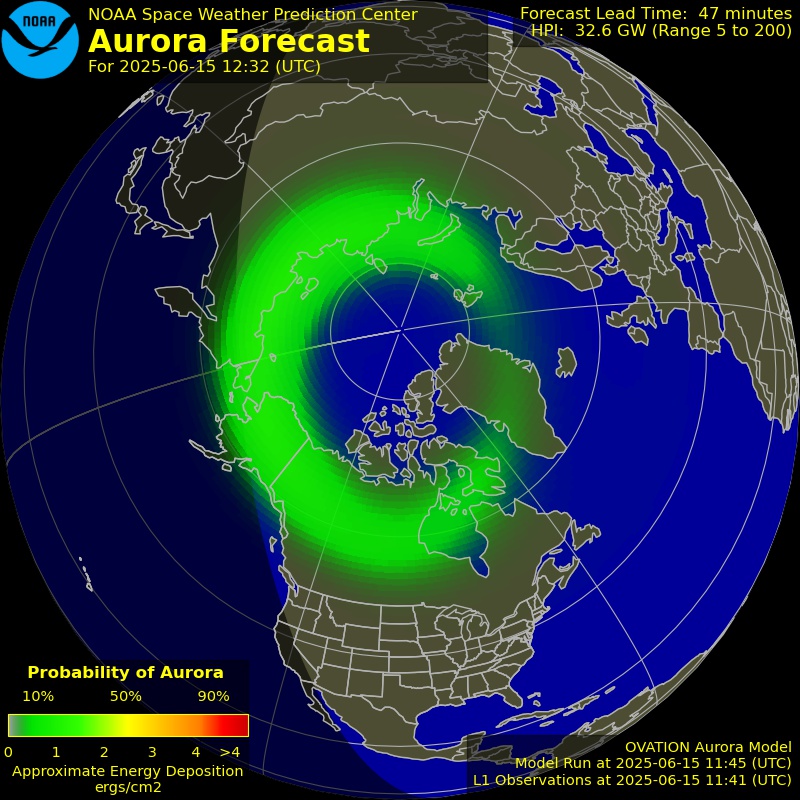
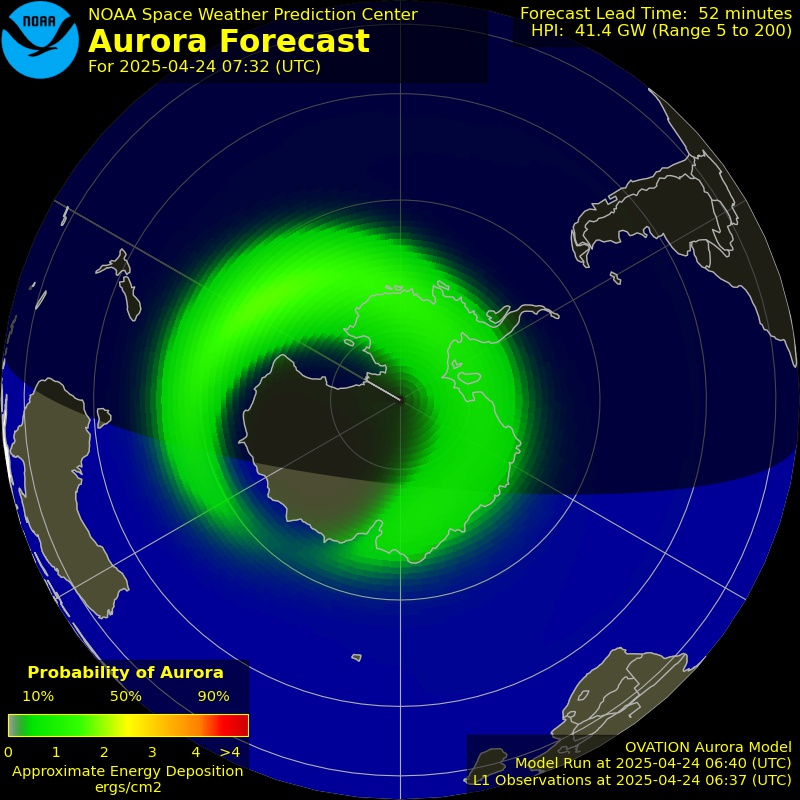
NOAA: the aurora is typically shown as a green oval centred on Earth's magnetic pole, turning red where the aurora is forecast to be more intense, and it can be seen from as much as 1000 km away when it is bright and conditions are right.
Kp now and the 3-day forecast
| Date (UTC) | 00-03 UTC | 03-06 UTC | 06-09 UTC | 09-12 UTC | 12-15 UTC | 15-18 UTC | 18-21 UTC | 21-24 UTC |
|---|---|---|---|---|---|---|---|---|
| Wed Nov 04 | 2.33 observed | 2.67 observed | 1.67 forecast | 1.33 forecast | 1.33 forecast | 0.67 forecast | 0.67 forecast | 1.67 forecast |
| Thu Nov 05 | 2.67 forecast | 3.00 forecast | 3.67 forecast | 2.67 forecast | 2.67 forecast | 1.67 forecast | 1.67 forecast | 2.67 forecast |
| Fri Nov 06 | 2.33 forecast | 1.67 forecast | 2.00 forecast | 2.33 forecast | 2.33 forecast | 2.33 forecast | 2.33 forecast | 2.33 forecast |
- Greatest observed 3-hour Kp over the past 24 hours: 2 (NOAA 3-day forecast issued 2026 Nov 04 0030 UTC).
- Greatest expected 3-hour Kp for Nov 04-Nov 06 2026: 3.67.
- NOAA's rationale: “No G1 (Minor) or greater geomagnetic storms are expected. No significant transient or recurrent solar wind features are forecast.”
Sources: NOAA SWPC Planetary K-index forecast file and 3-day forecast text; current value is NOAA's one-minute estimated Kp. Slots are 3-hour blocks in UTC; bold = observed, otherwise forecast. A G1 to G5 label is NOAA's own geomagnetic storm scale.
What Kp means for how far from the pole the lights reach
What Kp is
NOAA: the K-index quantifies disturbances in the horizontal component of Earth's magnetic field with an integer from 0 to 9, with 1 being calm and 5 or more indicating a geomagnetic storm. The planetary Kp is the mean standardised K-index from 13 geomagnetic observatories between 44 and 60 degrees north or south geomagnetic latitude, over a three-hour interval.
| Kp | What NOAA says about the aurora |
|---|---|
| 0 to 2 | The aurora will be far north, quite dim in intensity, and not very active. |
| 3 to 5 | The aurora moves further from the poles, becomes brighter and there is more auroral activity (motion and formations). Kp 5 is level G1 (Minor) on NOAA's scale: commonly visible at high latitudes (northern Michigan and Maine). |
| 6 to 7 | Even further from the poles, quite bright and active; it might be possible to see it from the northern edge of the United States. G2 (Kp 6): seen as low as New York and Idaho (typically 55° geomagnetic latitude). G3 (Kp 7): as low as Illinois and Oregon (50°). |
| 8 to 9 | Towards the equator, very bright and very active; aurora may be seen directly overhead from the northern states of the USA. G4 (Kp 8, including 9-): as low as Alabama and northern California (45°). G5 (Kp 9): as low as Florida and southern Texas (40°). |
NOAA also states an approximate rule: at Kp 0 the equator-side edge of the auroral oval is at about 66 degrees geomagnetic latitude and it moves about 2 degrees towards the equator for each Kp level, reaching about 48 degrees at Kp 9. This holds in geomagnetic, not geographic, latitude and is approximate; NOAA adds that the aurora can often be seen hundreds of kilometres equator-ward of the oval itself. Source: NOAA SWPC, Tips on viewing the aurora and NOAA Space Weather Scales.
At the current estimated Kp of 3, that rule puts the equator-side edge of the oval at roughly 60 degrees geomagnetic latitude.
How to see the northern and southern lights
- Go where it is dark. NOAA lists darkness as one of four factors: go out at night and get away from city lights. The full moon diminishes the apparent brightness of the aurora, not the actual brightness.
- Find a wide view towards the pole. Look north in the northern hemisphere and south in the southern. NOAA says that from a good vantage point with an unobstructed view, aurora can be seen even when it is 1000 km further towards the pole.
- Check the cloud and give it time. The table above shows the clearest dark hour for each place. Aurora can build and fade over a night, so plan to stay out for a while rather than step out for five minutes; give your eyes about 30 minutes to adjust to the dark. That is general advice, not a NOAA statement.
- Mind the season. NOAA notes that high latitudes do not get dark in summer, so a summer trip to the Arctic usually does not work for aurora. It also says autumn and spring, around the equinoxes, tend to bring larger geomagnetic storms.
- No promises. A forecast shows odds, not a guarantee, and the aurora can switch on or fade within minutes. The official NOAA and national weather services govern.
Plan the trip
Live travel conditions for the countries where these places sit:
City guides in the same countries and regions:
Quick answers
- What is the Kp index?
- It is NOAA's measure of disturbance in Earth's magnetic field, a number from 0 to 9 where 1 is calm and 5 or more indicates a geomagnetic storm. It is the mean of the standardised K-index from 13 observatories over three hours. It is 3 right now (NOAA estimate at 07:58 UTC).
- What is the best time of night to see the aurora?
- NOAA says the best aurora is usually within an hour or two of midnight, between 10 PM and 2 AM local time, and that activity expands towards evening and morning when geomagnetic activity is higher. It must also be dark, so the table above lists each place's dark hours and its clearest hour.
- Can I see the aurora in Fairbanks tonight?
- On the numbers above, Fairbanks: NOAA aurora chance 26%, average cloud 54% over 12 dark hours, clearest dark hour Wed 00:00 local. That is the top-ranked place on our recipe, but it is a forecast, not a promise; check the cloud again before you go.
- Does a full moon matter?
- NOAA says the full moon diminishes the apparent brightness of the aurora (not the actual brightness). Our score takes off up to 30% for a fully lit moon that is above the horizon all night; that weight is our own choice. Tonight the moon is about 23% lit at Fairbanks.
- Can you see the aurora in the southern hemisphere?
- Yes, NOAA publishes a southern hemisphere aurora map as well, and it is built into the table. Hobart: NOAA aurora chance 0%, average cloud 45% over 7 dark hours, clearest dark hour Thu 00:00 local; Lake Tekapo: NOAA aurora chance 0%, average cloud 34% over 8 dark hours, clearest dark hour Thu 00:00 local; Dunedin: NOAA aurora chance 0%, average cloud 74% over 7 dark hours, clearest dark hour Thu 01:00 local.
- How far from the poles can the aurora be seen?
- NOAA's scale says aurora is commonly visible at high latitudes at Kp 5 (G1), and has been seen as low as New York and Idaho at Kp 6 (G2), Illinois and Oregon at Kp 7 (G3), Alabama and northern California at Kp 8 (G4), and Florida and southern Texas at Kp 9 (G5). For lower Kp, use the aurora chance column, which comes from NOAA's own map.
Aurora forecast, Kp index and 3-day forecast: NOAA Space Weather Prediction Center, public domain, observed Nov 04, 07:53 UTC. Cloud cover: weather data from MET Norway, licensed CC BY 4.0; fetched with our own identifying User-Agent. Sun and moon positions are calculated with the open-source astral library. Place coordinates are those of the town centre; names and rankings are Voyaggora's own selection and calculation. This page is information only; the official NOAA and national weather service forecasts govern.